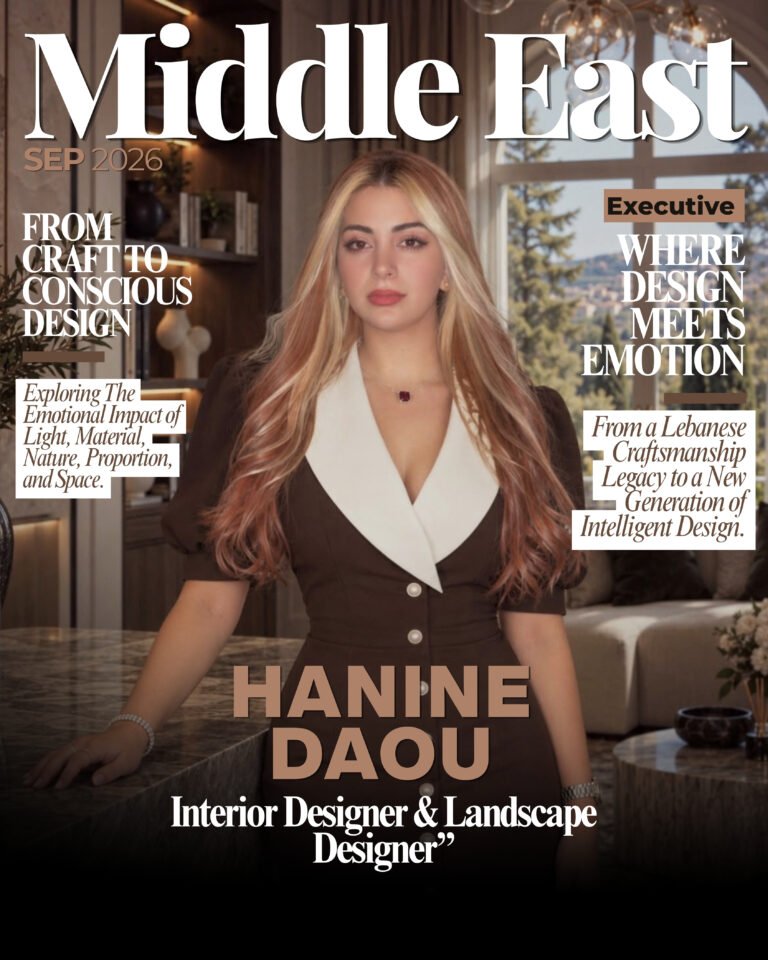
In contemporary design, creating a beautiful space is no longer simply about aesthetics. Increasingly, designers are exploring a deeper question: How does a space make us feel?
For Lebanese interior and landscape designer Hanine Daou, that question has become central to her creative philosophy.
As Partner and Lead Designer at RedOak Design, Daou brings together interior design, landscape design, custom furniture, material expertise, and hands-on execution to create environments that are not only visually refined, but emotionally and sensorially considered.
Her multidisciplinary approach combines soft luxury, biophilic principles, technical precision, and what she describes as material intelligence. At the heart of her practice is a growing interest in neuroarchitecture and emotional architecture—understanding how light, materials, nature, proportion, colour, and sensory experiences can influence how people feel, behave, and connect with their surroundings.
Her guiding philosophy is simple yet powerful:
“Designing the feeling. Building the reality.”
Rooted in Craftsmanship
Daou’s relationship with design began long before her professional career.
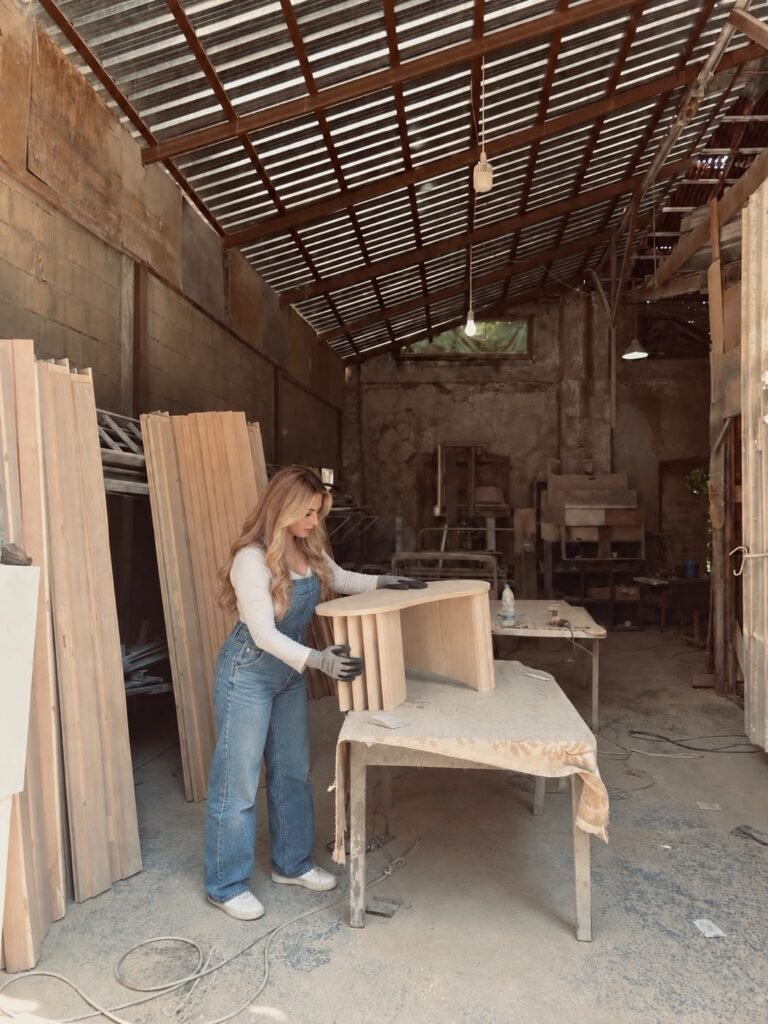
She grew up within a Lebanese family craftsmanship legacy established in the 1990s, surrounded by workshops, materials, craftsmen, and the process of making.
This environment gave her an early understanding that design is not simply an idea presented on paper. It is something that must eventually become physical—a relationship between concept, material, craftsmanship, technique, and execution.
Being exposed to skilled craftspeople from an early age also developed her appreciation for the details that often determine the character of a finished space.
For Daou, craftsmanship remains an essential part of contemporary design. Technology can expand possibilities, but the knowledge of materials and the human ability to understand how they should be shaped, combined, and experienced remain fundamental.
A Multidisciplinary Design Practice
At RedOak Design, Daou brings multiple disciplines together rather than treating them as separate creative categories.
Her practice encompasses interior design, landscape design, custom furniture, and hands-on execution, allowing her to consider a project as a complete environment.
This integrated approach enables her to explore how architecture, interiors, furniture, materials, landscape, and sensory elements interact.
Rather than designing individual elements in isolation, she considers how they contribute to the experience of the whole.
Her aesthetic is shaped by soft luxury, sensory design, biophilic principles, material intelligence, and technical precision.
The result is an approach that seeks to balance sophistication with warmth and functionality with emotional resonance.
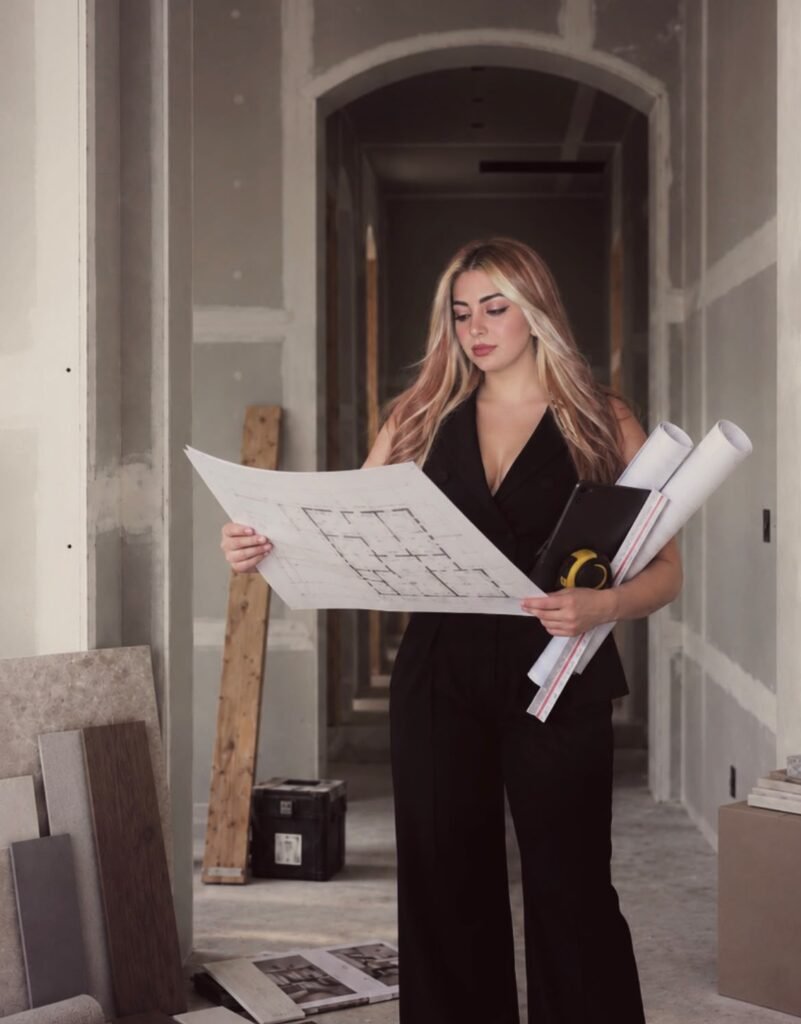
Designing for the Nervous System
One of the most important areas of Daou’s evolving practice is neuroarchitecture.
The discipline explores how the built environment can influence human psychological and physiological responses.
For Daou, this means looking beyond conventional questions of colour palettes, furniture arrangements, or visual style.
She is increasingly interested in the relationship between the physical environment and the nervous system.
How does natural light affect a person’s experience of a room?
How do materials influence sensory perception?
How does the presence of nature change the atmosphere of a space?
How do proportions, colours, textures, sounds, and spatial transitions influence behaviour and emotional responses?
These questions are becoming increasingly important to her design methodology.
The objective is to create environments that are not merely attractive, but intentionally supportive of how people live, work, rest, interact, and connect.
The Power of Emotional Architecture
Closely connected to neuroarchitecture is Daou’s interest in emotional architecture.
She believes that spaces communicate through more than their visual appearance. They can create feelings of calm, energy, intimacy, openness, comfort, curiosity, or connection.
This perspective changes the role of the designer.
Instead of beginning only with the question of what a space should look like, Daou considers what it should feel like.
That shift places human experience at the centre of the design process.
Light, texture, colour, natural elements, material transitions, proportions, and spatial flow become tools for shaping emotional experiences.
It is an approach that recognises that people do not simply occupy spaces—they experience them.
Art, Theatre and the Language of Transformation
Daou’s creative perspective has also been shaped by her background in visual art and special effects for theatre.
Theatre provided her with an understanding of transformation, illusion, atmosphere, colour, texture, and storytelling.
That experience continues to influence the way she approaches physical environments.
Theatre is fundamentally about creating an emotional experience through visual and sensory elements. Daou brings a similar sensitivity to interior and landscape design, considering how materials, lighting, movement, and spatial composition can contribute to a narrative.
Her artistic background allows her to view a space not merely as a static composition, but as an environment capable of evolving emotionally as people move through it.
Material Intelligence and Sensory Design
Material selection is another defining aspect of Daou’s work.
Her early exposure to workshops and craftsmanship created an appreciation for materials that goes beyond their appearance.
She considers how materials feel, respond to light, interact with other surfaces, and contribute to the sensory character of a space.
This understanding of material intelligence allows her to combine technical precision with emotional sensitivity.
A material can be visually luxurious, but its tactile quality, temperature, texture, sound, or relationship with natural light can fundamentally change how it is experienced.
For Daou, these details are not secondary considerations. They are part of the architecture of feeling.
Bringing Nature Into Everyday Experience
Biophilic design is another important component of Daou’s practice.
Her work explores the relationship between built environments and nature, recognising that natural elements can contribute significantly to the sensory and emotional experience of a space.
Landscape design therefore becomes more than an external addition to architecture. It can become an extension of the interior environment and an important part of how people move between spaces.
The integration of nature, light, materials, and spatial proportion allows her to create environments that feel more connected to their surroundings.
This connection reflects her broader belief that good design should consider the whole human experience rather than concentrating exclusively on visual aesthetics.
Human Intelligence × Artificial Intelligence
While rooted deeply in craftsmanship and human creativity, Daou is also embracing emerging technology.
She views artificial intelligence as a creative tool, rather than a replacement for human intelligence.
For her, AI can expand what designers are able to imagine, explore, test, and communicate. It can support the creative process and open new possibilities for experimentation.
But technology, in her view, should remain connected to the qualities that make design meaningful: intuition, craftsmanship, cultural understanding, emotional intelligence, and human experience.
This creates an interesting balance between tradition and innovation.
The knowledge inherited from craftsmen and accumulated through physical making can coexist with new digital tools and technologies.
For Daou, the future of design is therefore not about choosing between human intelligence and artificial intelligence.
It is about understanding how the two can work together.
Preserving What Makes Design Human
Daou’s approach to AI reflects a broader philosophy within her practice.
As technology becomes increasingly capable of generating images, concepts, and design possibilities, she believes the role of the human designer becomes even more important.
Intuition cannot be reduced to a prompt.
Cultural understanding cannot simply be automated.
Craftsmanship is built through experience.
And emotional meaning comes from understanding people.
These qualities provide the foundation through which technology can be used responsibly and creatively.
Daou’s approach therefore places technology within a human-centred framework, using innovation to expand creative possibilities while protecting the cultural and emotional dimensions of design.
Designing the Feeling
At the centre of Hanine Daou’s philosophy is a fundamental shift in how spaces are understood.
Design is not only about what people see.
It is about what they experience.
It is about the atmosphere created by light, the feeling generated by natural materials, the emotional response to colour, the sense of calm created through proportion, and the connection that emerges when nature becomes part of the environment.
This is what Daou means by “Designing the feeling.”
The designer’s role becomes one of shaping experiences as much as shaping physical environments.
Building the Reality
The second half of Daou’s philosophy—“Building the reality”—reflects her connection to craftsmanship and execution.
Ideas must eventually become physical spaces.
Concepts must withstand technical realities.
Materials must be sourced, shaped, assembled, and installed.
Design must move from imagination into reality.
Her experience growing up around craftsmen gives this principle particular significance. She understands that the success of a design is ultimately measured not only by the strength of its concept, but by the quality of its execution.
This combination of creative vision and practical knowledge allows Daou to approach projects from both sides: imagining what a space can become and understanding what it takes to make that vision real.
A New Direction for Contemporary Design
Hanine Daou’s work reflects a broader evolution taking place within contemporary design—one that moves beyond visual aesthetics toward human experience.
Her multidisciplinary practice brings together interiors, landscapes, furniture, art, technology, craftsmanship, and sensory design.
Her growing focus on neuroarchitecture and emotional architecture adds another layer, asking designers to consider the relationship between physical environments and the people who inhabit them.
At RedOak Design, this philosophy is expressed through an approach that combines heritage with innovation, technical knowledge with intuition, and human intelligence with emerging technology.
Ultimately, Daou’s vision is about creating spaces that do more than look beautiful.
They should make people feel.
And through her guiding philosophy—“Designing the Feeling. Building the Reality.”—she is developing a design language where craftsmanship, technology, nature, emotion, and human experience come together to shape environments with meaning.