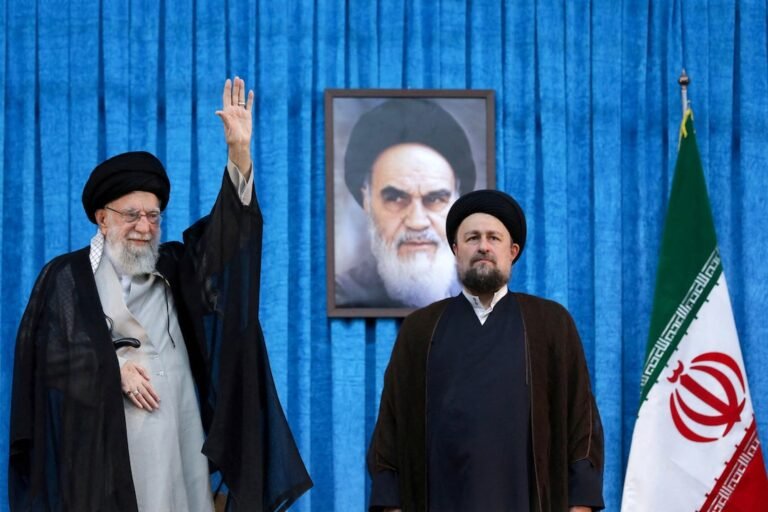
With Ayatollah Ali Khamenei in hiding and under threat, insiders reveal Mojtaba Khamenei and Hassan Khomeini as frontrunners in a race that could reshape the Islamic Republic’s future
As tensions mount following Israeli and U.S. strikes on Iran, the country’s clerical leadership is fast-tracking preparations for a sensitive and pivotal transition: the eventual succession of Supreme Leader Ayatollah Ali Khamenei. At 86 years old and facing renewed threats to his life, Khamenei is being closely guarded by the elite Vali-ye Amr unit and remains in seclusion with his family, while high-level succession talks intensify behind the scenes.
Five insiders with knowledge of the discussions told Reuters that a special three-member committee—formed from within the powerful Assembly of Experts and handpicked by Khamenei two years ago—has accelerated its succession planning in recent days, prompted by recent Israeli threats and the assassination of key Revolutionary Guard commanders.
Despite Khamenei’s preference to keep succession conversations private and vague, sources confirm he is now regularly updated on developments. While the situation is fluid, two frontrunners have emerged in the deliberations: Mojtaba Khamenei, the Supreme Leader’s influential but officially low-profile son, and Hassan Khomeini, the reform-minded grandson of Iran’s revolutionary founder Ayatollah Ruhollah Khomeini.
A Tale of Two Candidates
Mojtaba Khamenei, 56, is a cleric and theologian based in Qom, revered among hardliners for his ideological alignment with his father. Despite lacking formal office, he exerts significant influence as his father’s gatekeeper. However, his visibility and perceived inheritance of authority have raised concerns about the optics of dynastic rule—a sensitive issue in post-revolution Iran.
In contrast, Hassan Khomeini, 53, carries his grandfather’s legacy with a reformist edge. A close ally of Iran’s moderate political factions, he has long advocated for easing domestic restrictions and opening up to the world. Though barred from running for the Assembly of Experts in 2016, his voice carries weight among both clerics and the Revolutionary Guards due to his lineage. His recent public support for Khamenei during U.S. airstrikes has further elevated his standing as a potential unifier.
Strategic Calculations in a Shifting Landscape
Sources say the succession committee faces a dilemma: maintain hardline continuity with Mojtaba, or opt for a more moderate figure like Khomeini to help quell domestic unrest and ease international isolation. While Mojtaba offers ideological consistency, Khomeini could project a softer, more diplomatic face amid mounting economic woes and popular dissatisfaction.
“This is about preserving the system while managing the optics,” said one insider. “The establishment wants someone rooted in the revolution, but who can also lower the temperature.”
The succession urgency has grown since the Israeli assassination of Hezbollah’s Hassan Nasrallah and intensified U.S. military action. Former President Donald Trump recently claimed, “We know exactly where the so-called ‘Supreme Leader’ is hiding,” calling for Tehran’s unconditional surrender. These threats have pushed succession planning into overdrive.
A Shrinking Bench of Candidates
Many former succession candidates have died in recent years, including former presidents Hashemi Rafsanjani and Ebrahim Raisi, and judiciary chief Mahmoud Hashemi Shahroudi. Others, such as Sadegh Amoli Larijani and Alireza Arafi, are still technically contenders but have lost momentum.
There is also speculation that the Revolutionary Guards may attempt to install a relatively unknown figure to act as a proxy, allowing the elite force to pull the strings behind the scenes. “It’s possible they’ll choose someone low-profile, essentially a figurehead,” said Ali Vaez of the International Crisis Group.
A Precarious Path Forward
Iran’s 1989 succession saw Khamenei himself—then a mid-ranking cleric—elevated unexpectedly after the death of the Republic’s founder. Initially dismissed by many as weak, he consolidated power steadily over decades, using the Revolutionary Guards to sideline rivals and maintain control. His successor, however, may not find such a clear path.
As Iran’s economy falters, public discontent rises, and regional tensions escalate, the stakes of this transition have never been higher. Whether the Islamic Republic chooses a hardline guardian of the revolution or a reformist heir to its founder’s legacy, the outcome will reverberate far beyond Tehran.
“In any case,” said one insider, “it won’t be the same Islamic Republic we’ve known for the past 45 years. The next chapter is being written right now.”