Historic visit highlights nearly 50 years of diplomatic ties and deepens US-UAE cooperation in trade, AI, energy, and space
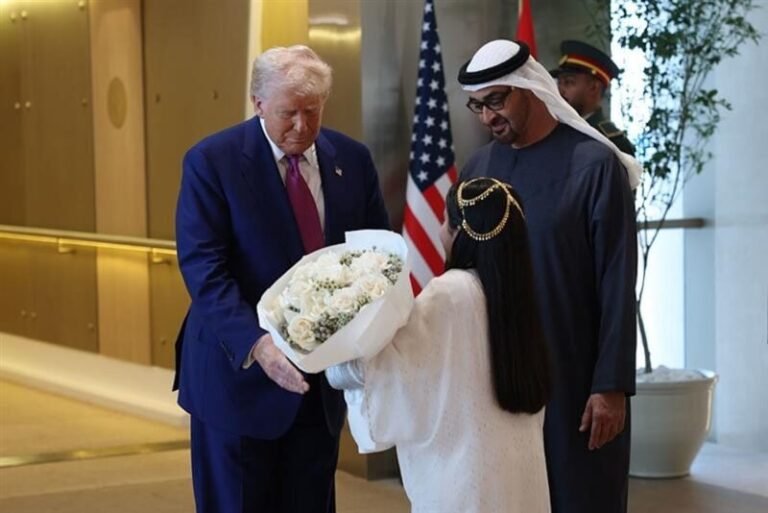
Abu Dhabi, UAE — In a landmark moment for international diplomacy, US President Donald Trump arrived in Abu Dhabi on the final leg of his Middle East tour, receiving a ceremonial welcome from UAE President His Highness Sheikh Mohamed bin Zayed Al Nahyan. The visit underscores the strength and strategic depth of the nearly five-decade-long relationship between the United States and the United Arab Emirates.
President Trump, whose regional tour also included stops in Saudi Arabia and Qatar, was greeted at the Presidential Airport by a high-level delegation of Emirati officials, including Sheikh Tahnoon bin Zayed Al Nahyan, Deputy Ruler of Abu Dhabi and National Security Adviser; Sheikh Abdullah bin Zayed Al Nahyan, Deputy Prime Minister and Minister of Foreign Affairs; and several senior advisors and ministers. In a mark of honour, Air Force One was escorted into UAE airspace by a ceremonial squadron of military jets, with the lead pilot extending a warm radio welcome on behalf of the Emirates.
Described by White House press secretary Karoline Leavitt as a “historic return to the Middle East,” the visit seeks to expand bilateral cooperation across multiple strategic areas, including development, trade, innovation, energy, and security.
Strengthening Economic and Trade Ties
The UAE stands as the US’s top trading partner in the Middle East and North Africa. In 2024, non-oil trade between the two nations reached $32.8 billion. The UAE is also one of the largest foreign investors in the US, with an estimated $1 trillion invested across key sectors such as advanced technology, aviation, energy, and artificial intelligence.
The visit reinforces these economic bonds and opens new avenues for bilateral trade and investment, particularly as both nations focus on sustainable development and technological innovation.
Advancing Artificial Intelligence Collaboration
AI has emerged as a cornerstone of US-UAE cooperation. In 2024, the two countries unveiled a comprehensive framework for collaboration in artificial intelligence, marked by several significant developments:
- Microsoft’s $1.5 billion investment in UAE-based G42.
- The launch of the first AI integration centre in Masdar City by World Wide Technology and NXT-Global.
- Establishment of the “Responsible AI Foundation” to guide ethical AI development.
- Formation of the AI Infrastructure Partnership, aiming to mobilise up to $100 billion in global capital to advance AI capabilities.
These initiatives signify a shared vision of technological leadership and responsible AI innovation on the global stage.
Strategic Energy and Space Cooperation
Energy remains a pillar of the US-UAE alliance. ADQ and US-based Energy Capital Partners have pledged $25 billion in joint investments targeting US-based power generation, underscoring the nations’ aligned goals for energy security and sustainability.
Space collaboration is also ascending to new heights. Building on the UAE’s successful Hope Probe mission to Mars, the country is now contributing a crew airlock module to NASA’s Lunar Gateway project and plans to send its first astronaut into lunar orbit by 2030.
A Shared Vision for the Future
Established in 1971, diplomatic ties between the US and the UAE were formally cemented with the opening of embassies in 1974. Since then, the partnership has evolved into a robust alliance grounded in mutual respect, economic integration, and forward-looking innovation.
President Trump’s visit not only honours this enduring relationship but also lays the foundation for even greater collaboration in the years ahead. As both nations navigate a rapidly changing global landscape, their partnership stands as a model of strategic cooperation, innovation, and shared prosperity.